



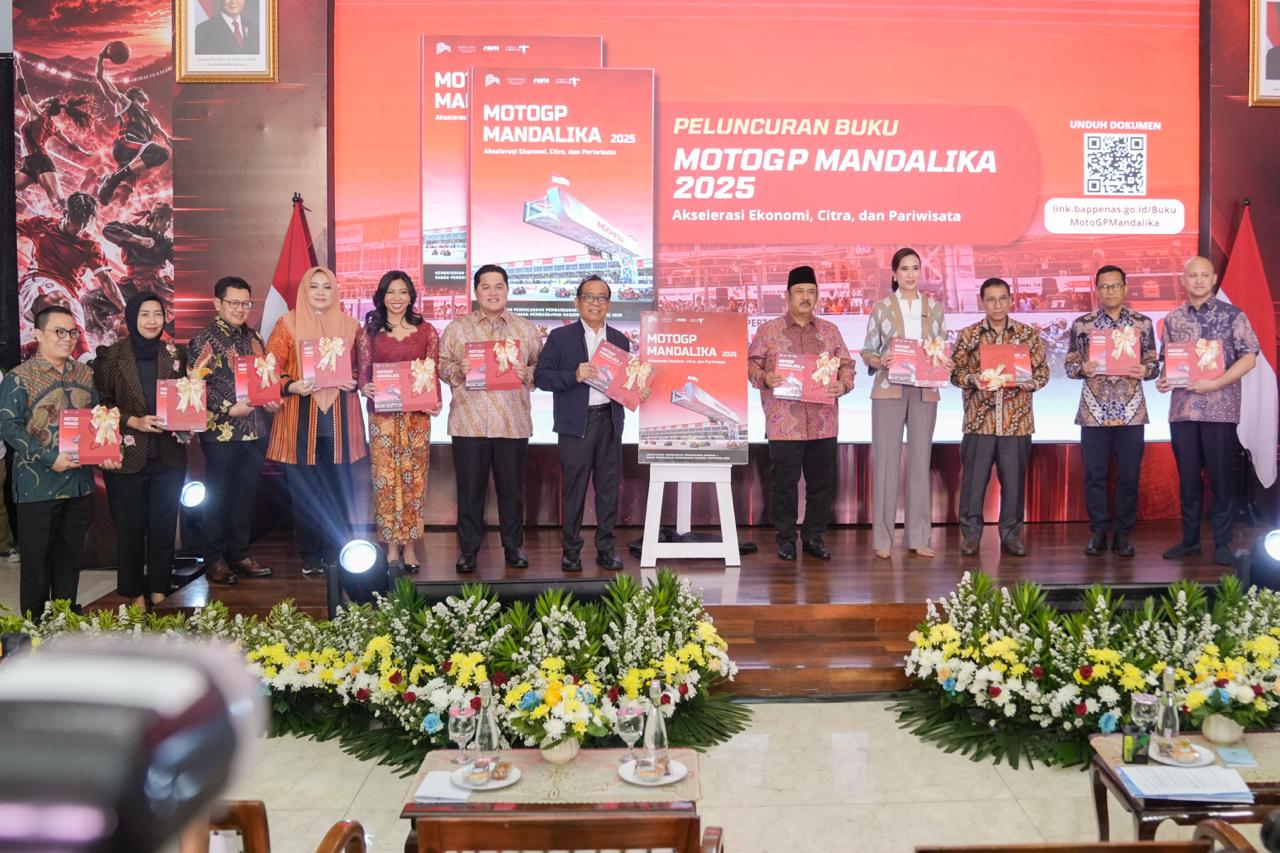
Jakarta – The Ministry of National Development Planning/National Development Planning Agency (Bappenas) launched the MotoGP Mandalika 2025: Accelerating the Economy, Image, and Tourism book and simultaneously initiated the development of the Grand Design for the Development of the National Sports Industry at the Bappenas Building on Wednesday (30 September). The study in the book estimates that the economic impact of the Pertamina Grand Prix of Indonesia 2025 reached approximately IDR 2.7–4.7 trillion. These findings serve as a foundation for developing policies on sports tourism and the national sports industry.
The book is the result of a study conducted by the Ministry of National Development Planning/Bappenas in collaboration with PT Pengembangan Pariwisata Indonesia (Persero), also known as InJourney Tourism Development Corporation (ITDC), and Mandalika Grand Prix Association (MGPA), part of the State-Owned Enterprises (SOE) Aviation and Tourism Holding Company PT Aviasi Pariwisata Indonesia (Persero), or InJourney. The study was developed collaboratively with the Coordinating Ministry for Economic Affairs, the Coordinating Ministry for Human Development and Cultural Affairs, the Ministry of Tourism, the Ministry of Youth and Sports, the Ministry of State Secretariat, Statistics Indonesia (BPS), and Bank Indonesia. The study aims to accelerate the development of MotoGP Mandalika as a strategic instrument for national development in the future.
“Lessons learned from MotoGP Mandalika demonstrate the importance of developing an integrated sports industry ecosystem. The potential of the sports industry has not yet been fully converted into added value, investment, and employment opportunities domestically. The ecosystem remains fragmented, ranging from data, products, and industries to human resources and the utilization of sports infrastructure,” said Minister of National Development Planning/Head of Bappenas Rachmat Pambudy in his remarks.
The estimated economic impact includes direct, indirect, and induced impacts. MotoGP Mandalika also contributed to the creation of tens of thousands of employment opportunities during the preparation and implementation stages, benefiting the tourism, MSME, transportation, accommodation, creative economy, and local community sectors in West Nusa Tenggara (NTB). In terms of promotion, global media exposure generated an Advertising Value Equivalency (AVE) of EUR 361.6 million, or approximately IDR 6.9 trillion, reflecting the promotional value generated for Indonesia and Mandalika.
The Ministry of National Development Planning/Bappenas and ITDC conducted a survey during MotoGP Mandalika 2025 involving more than 1,800 respondents, comprising domestic spectators, international tourists, MSME operators, workers, and sponsors. The spectator experience score (brand equity) reached 5.07 on a scale of 6.
The survey also indicated tourists’ intention to revisit Indonesia. The study estimates that increased exposure for Mandalika could potentially boost tourist arrivals by approximately 11 percent, if supported by integrated destination promotion.
“MotoGP Mandalika has demonstrated how a world-class sporting event can strengthen a destination’s appeal, increase tourist arrivals, extend tourists’ length of stay, and stimulate the local economy. Synergy between the tourism and sports sectors will continue to be strengthened as part of the development of Indonesia’s sports tourism,” said Minister of Tourism Widiyanti Putri Wardhana.
The benefits to the local economy can be seen through MSME participation, increased business activity, and employment opportunities. The survey recorded a satisfaction score of 5.51 out of 6 among workers and volunteers, while overall satisfaction among MSME operators and tenants reached 5.23.
Support from the NTB Provincial Government as well as regency and city governments also contributed to the successful implementation of MotoGP Mandalika. The study noted budgetary support for event organization, tourism promotion, healthcare services, security, infrastructure improvements, and supporting activities that strengthened the economic impact on local communities.
NTB Deputy Governor Indah Dhamayanti Putri also attended the event. For the NTB Provincial Government, Mandalika is a strategic regional asset. The success of MotoGP is measured not only by spectator numbers, but also by strengthening Mandalika’s image, the quality of the tourist experience, and its sustainable contribution to the regional economy.
“MotoGP Mandalika demonstrates that international sporting events can serve as catalysts for sustainable area development. For ITDC, this momentum needs to be transformed from a mere event-based economy into event-led development, so that the economic, social, and area development benefits can continue to be felt over the long term. With more than 52 years of experience, ITDC continues to strengthen its role as Master Developer and Asset Manager through the development of integrated infrastructure, facilities, and services, as well as strategic collaboration with industry players and communities surrounding the area. This effort is part of ITDC’s commitment to strengthening The Mandalika as a world-class sports tourism destination that delivers sustainable added value for the area and local communities,” said ITDC Acting President Director Ahmad Fajar.
Lessons learned from MotoGP Mandalika have become the foundation for strengthening sports industry policies. As part of the same event, the Ministry of National Development Planning/Bappenas initiated the development of the Grand Design for the Development of the National Sports Industry.
“The Ministry of National Development Planning/Bappenas has initiated the development of the Grand Design for the Development of the National Sports Industry as a shared reference that will establish the direction, focus, targets, and division of roles across sectors,” said Minister Rachmat Pambudy.
The document will serve as a reference for developing a sustainable sports industry ecosystem by strengthening coordination between the central and regional governments, clarifying the roles and responsibilities of stakeholders, and strengthening monitoring and evaluation.
“The development of the sports industry must become a collective movement. Sports achievements, the sports industry, and international event organization mutually reinforce one another. Cross-ministerial collaboration is the foundation for enabling Indonesia to increasingly host various world-class sporting events in a professional and sustainable manner while delivering tangible benefits to the public,” said Minister of Youth and Sports Erick Thohir.
The Government expects the findings of this study to serve as a basis for policies on the development of sports tourism and the sports industry, while supporting the achievement of national development targets under the 2025–2029 National Medium-Term Development Plan (RPJMN).
“Ultimately, what we want to build is not simply an increasing number of sporting events, but a stronger and more competitive Indonesian sports industry ecosystem that is capable of generating added value for the economy and improving public welfare,” concluded Minister Rachmat Pambudy.